


What is the thermal conductivity of Damascus steel knives?
As a supplier of Damascus steel knives, I often get asked about various properties of these remarkable blades, and one question that comes up quite frequently is about their thermal conductivity. In this blog post, I'll delve into what thermal conductivity is, how it relates to Damascus steel knives, and why it matters.
Understanding Thermal Conductivity
Thermal conductivity is a measure of a material's ability to conduct heat. It is defined as the quantity of heat that passes through a unit area of a material in a unit time when there is a unit temperature difference between opposite faces of the material. The SI unit for thermal conductivity is watts per meter - kelvin (W/(m·K)).
Materials with high thermal conductivity transfer heat quickly, while those with low thermal conductivity are good insulators and resist heat transfer. For example, metals generally have high thermal conductivity because they have free electrons that can move easily and transfer heat energy. On the other hand, materials like wood and plastic have low thermal conductivity and are often used for handles on knives to insulate the user's hand from the heat of the blade.
Thermal Conductivity of Damascus Steel
Damascus steel is a type of steel known for its distinctive wavy pattern and excellent cutting performance. Traditional Damascus steel was made by forge - welding different types of steel together, creating a composite material with unique properties. Modern Damascus steel is often made using similar techniques, combining different alloys to achieve the characteristic pattern and desired performance.
The thermal conductivity of Damascus steel depends on several factors, including the specific alloys used in its composition. Generally, steel has a relatively high thermal conductivity compared to many other materials. Most steels have a thermal conductivity in the range of 40 - 60 W/(m·K). However, the exact value for Damascus steel can vary because it is a composite material.
The different layers of steel in Damascus steel may have slightly different thermal conductivities. When heat is applied to a Damascus steel knife, the heat will spread through the blade according to the combined thermal properties of these layers. The forging process can also affect the thermal conductivity to some extent. If the layers are well - bonded during forging, heat transfer will be more efficient, resulting in a more uniform thermal conductivity across the blade.
Why Thermal Conductivity Matters in Damascus Steel Knives
Thermal conductivity plays an important role in the performance and usability of Damascus steel knives. Here are a few reasons why:
Heat Dissipation
When a knife is used for cutting, especially during heavy - duty tasks like chopping through tough materials, friction is generated between the blade and the material being cut. This friction produces heat, which can cause the blade to become hot. A knife with good thermal conductivity will be able to dissipate this heat quickly, preventing the blade from overheating. Overheating can lead to a loss of hardness and sharpness in the blade, reducing its cutting performance.
Comfort of Use
If the handle of a knife is not well - insulated from the blade, a high - thermal - conductivity blade can transfer heat to the user's hand. This can be uncomfortable, especially during extended use. That's why many Damascus steel knives are designed with handles made of materials with low thermal conductivity, such as wood, bone, or synthetic polymers. These materials act as insulators, protecting the user's hand from the heat of the blade.
Cooking Applications
In the kitchen, thermal conductivity can also be important. For example, when using a Damascus steel chef's knife to cut hot food or to perform tasks like slicing through a hot roast, a blade with good thermal conductivity can help to prevent the food from sticking to the blade. The heat from the food is transferred away from the cutting edge, reducing the likelihood of the food adhering to the blade.
Our Damascus Steel Knives and Thermal Conductivity
At our company, we take great care in selecting the materials and manufacturing processes for our Damascus steel knives to ensure optimal thermal conductivity. We use high - quality alloys that are known for their excellent heat - transfer properties. Our forging techniques ensure that the layers of steel in the Damascus pattern are well - bonded, promoting efficient heat transfer across the blade.

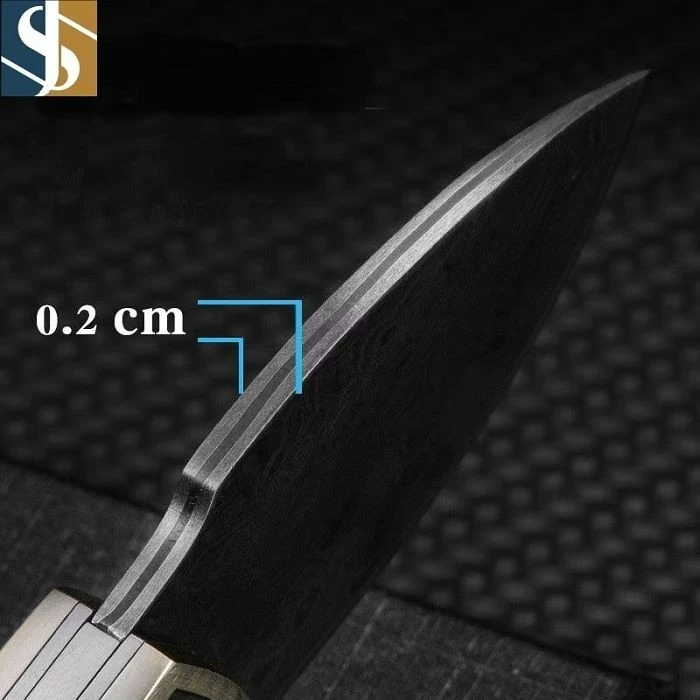
We offer a wide range of Damascus steel knives, each designed with different applications in mind. For example, our Damascus Shell Handle Small Folding Knife is perfect for everyday carry. The shell handle provides a comfortable grip and acts as an insulator, protecting your hand from the heat of the blade.
Our Mini Damascus Beef Bone Handle Folding Knife is another popular choice. The beef bone handle not only adds a touch of elegance but also helps to insulate the hand from the heat generated during use.
If you're looking for a more specialized knife, our Mini Damascus Tanto Knife is a great option. The tanto blade design is known for its strength and durability, and our Damascus steel construction ensures efficient heat dissipation during heavy - duty tasks.
Conclusion
The thermal conductivity of Damascus steel knives is an important property that affects their performance, usability, and comfort of use. Our company is committed to producing high - quality Damascus steel knives that offer excellent thermal conductivity and other desirable properties. Whether you're a professional chef, an outdoor enthusiast, or someone who appreciates a well - crafted knife, our Damascus steel knives are sure to meet your needs.
If you're interested in purchasing our Damascus steel knives or have any questions about their thermal conductivity or other properties, please don't hesitate to contact us for a procurement discussion. We look forward to serving you and providing you with the best Damascus steel knives on the market.
References
- Callister, W. D., & Rethwisch, D. G. (2010). Materials Science and Engineering: An Introduction. Wiley.
- ASM Handbook Committee. (1990). ASM Handbook Volume 1: Properties and Selection: Irons, Steels, and High - Performance Alloys. ASM International.