


Hey there, fellow sword enthusiasts! I'm a supplier of Tanto swords, and I've seen my fair share of blades over the years. Today, I'm gonna share with you how to identify an authentic Tanto sword. It's not always easy, but with a bit of knowledge and some careful inspection, you can make sure you're getting the real deal.
1. Understanding the Tanto Sword
First things first, let's talk about what a Tanto sword is. The Tanto is a traditional Japanese dagger that dates back centuries. It was originally used as a weapon by samurais, often for stabbing or close - combat situations. Unlike other swords, the Tanto has a distinct shape. It usually has a straight or slightly curved blade with a single - edged or double - edged design. The blade is short, typically ranging from 15 to 30 centimeters, and it has a pointy tip that's super sharp.
2. Blade Material
One of the most important aspects of an authentic Tanto sword is the blade material. Traditionally, Tanto blades were made from high - carbon steel, specifically Tamahagane. Tamahagane is a type of steel that's made through a special smelting process. It has a unique grain pattern and excellent edge - holding properties.
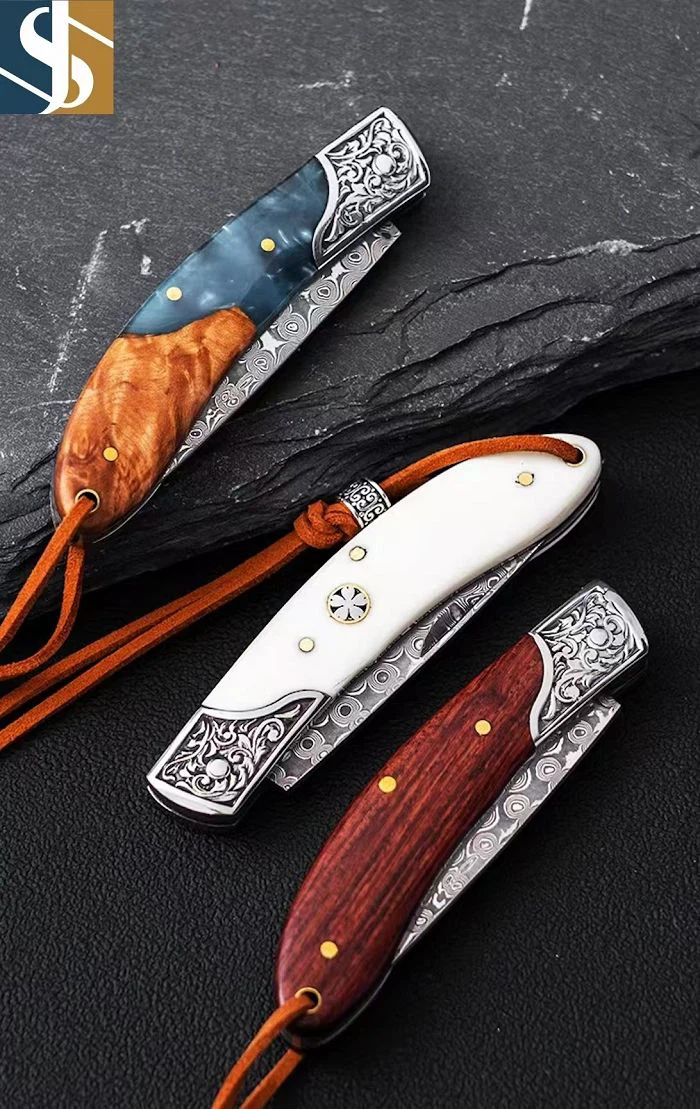
When you're looking at a Tanto sword, check the blade for signs of high - quality steel. A good blade should have a smooth finish and no visible cracks or pits. You can also look for the characteristic grain pattern. If the blade has a wavy or swirling pattern, it might be a sign of authentic Tamahagane or a high - quality Damascus steel. Speaking of Damascus steel, we also have some great options like the Damascus Pocket Knife with Abalone Shell Handle and the Mini Damascus Tanto Knife.
3. Blade Shape and Design
The shape and design of the blade are also key indicators of an authentic Tanto sword. As I mentioned earlier, the Tanto blade is short and has a distinct tip. The tip should be sharp and well - defined. It should also be in proportion to the rest of the blade.
The curvature of the blade is another important factor. While some Tanto blades are straight, others have a slight curve. The curve should be smooth and natural, not forced or uneven. Additionally, the blade should have a proper taper from the base to the tip. A well - made Tanto blade will feel balanced in your hand, which is crucial for both functionality and aesthetics.
4. Hamon (Temper Line)
The hamon is the temper line on the blade of a Japanese sword, and it's a tell - tale sign of an authentic Tanto. The hamon is created during the quenching process, which hardens the edge of the blade while leaving the spine softer. This creates a distinct line between the hard and soft parts of the blade.
The hamon can have different shapes and patterns, such as straight, wavy, or cloud - like. A real Tanto sword will have a well - defined and natural - looking hamon. If the hamon looks too perfect or artificial, it might be a sign that the sword is a fake. Inspect the hamon closely with a magnifying glass if possible to look for any signs of irregularities or inconsistencies.

5. Tang
The tang is the part of the blade that extends into the handle. It's an important part of the sword's construction, as it provides stability and strength. In an authentic Tanto sword, the tang should be full and well - made. A full tang means that the blade extends all the way through the handle, which is a sign of high - quality craftsmanship.
Check the tang for any signs of weakening or damage. It should be firmly attached to the handle and not loose or wobbly. You can also look at the shape of the tang. Traditional Tanto tangs have a specific shape that's designed to fit the handle properly.
6. Handle and Fittings
The handle and fittings of a Tanto sword can also give you clues about its authenticity. The handle, or tsuka, is usually wrapped in a material like ray skin or silk cord. The wrapping should be tight and even, with no loose ends or fraying.
The fittings, such as the tsuba (guard), menuki (ornamental grips), and kojiri (pommel), should be made from high - quality materials. Traditional Tanto fittings were often made from materials like brass, copper, or iron. They should be well - crafted and have a good finish. For example, our Damascus Bovine Bone Folding Knife has some really nice fittings that add to its overall appeal.
7. Signature and Markings
Many authentic Tanto swords have signatures or markings on the blade. These markings can include the name of the swordsmith, the date of production, or other important information. The signature should be engraved or etched onto the blade in a clear and legible manner.
If you're not familiar with Japanese sword markings, it can be a bit tricky to decipher them. However, there are many resources available online and in books that can help you learn more. Just be aware that some fake swords might have fake signatures, so you need to look at the overall quality of the sword in addition to the markings.
8. Weight and Balance
The weight and balance of a Tanto sword are also important factors. An authentic Tanto should feel balanced in your hand. It shouldn't be too heavy or too light. The weight should be distributed evenly along the blade and handle, which makes it easier to use and control.
You can test the balance by holding the sword at the guard and gently moving it around. It should feel comfortable and natural in your hand. If the sword feels top - heavy or unbalanced, it might not be a high - quality or authentic Tanto.
9. Price and Seller Reputation
Finally, consider the price and the reputation of the seller. Authentic Tanto swords are usually not cheap. If you see a Tanto sword being sold at an extremely low price, it's probably too good to be true. High - quality materials, craftsmanship, and the time it takes to make a real Tanto sword all contribute to its cost.
When you're buying a Tanto sword, make sure you're buying from a reputable seller. Look for reviews and testimonials from other customers. A good seller will be able to provide you with detailed information about the sword, including its origin, materials, and construction.
If you're interested in adding an authentic Tanto sword to your collection or using it for practical purposes, I'd love to talk to you. Whether you're a collector, a martial artist, or just someone who appreciates fine blades, I can help you find the perfect Tanto sword. Reach out to me, and we can start a conversation about your needs and preferences.
References
- "The Art of the Japanese Sword" by John Yumoto
- "Japanese Swords: A Collector's Guide" by Saburo Kato