


Testing the balance of a tanto sword is a crucial aspect, especially for a tanto sword supplier like me. A well - balanced sword not only enhances the user's experience but also reflects the quality of the product. In this blog, I will share several effective methods to test the balance of a tanto sword.
Understanding the Concept of Balance in a Tanto Sword
Before delving into the testing methods, it's essential to understand what balance means in the context of a tanto sword. Balance refers to the distribution of weight along the length of the sword. A properly balanced tanto sword will have its center of gravity in an optimal position, which can vary depending on the intended use of the sword, such as cutting, thrusting, or display.
Method 1: The Finger Test
The finger test is one of the simplest and most straightforward ways to test the balance of a tanto sword. Here's how you can do it:
- Hold the sword by placing your index finger horizontally under the blade, near the guard. Keep your finger steady and try to balance the sword on it.
- Slowly move your finger along the blade towards the tip. Pay attention to where the sword naturally balances. This point is the center of gravity of the sword.
- For a tanto sword used primarily for cutting, the center of gravity is typically a few inches from the guard. If it's too close to the tip, the sword may feel front - heavy and difficult to control during quick maneuvers. Conversely, if it's too close to the guard, the sword may lack the necessary momentum for powerful cuts.
Method 2: The Hanging Test
The hanging test provides another perspective on the sword's balance. Here are the steps:
- Tie a thin string or fishing line around the sword blade, just above the guard. Make sure the string is securely fastened.
- Hang the sword from a fixed point using the string. Allow the sword to come to rest naturally.
- Observe the angle at which the sword hangs. A well - balanced tanto sword will hang relatively straight, with only a slight tilt. If the sword hangs at a significant angle, it indicates an imbalance in the weight distribution.
- You can also compare the position of the center of gravity determined by the hanging test with the results of the finger test. They should be relatively close, validating the accuracy of your measurements.
Method 3: The Swinging Test
The swinging test simulates the actual use of the tanto sword and gives you a feel for its balance during movement. Here's what you need to do:
- Hold the sword firmly by the handle, using a proper grip. Make sure your grip is comfortable and secure.
- Swing the sword in a controlled arc, similar to the motion you would use for cutting. Start with slow, gentle swings and gradually increase the speed.
- Pay attention to how the sword feels in your hand. A balanced sword will feel smooth and easy to control during the swing. You should be able to change the direction of the swing quickly and without much effort.
- If the sword feels cumbersome or difficult to maneuver, it may be out of balance. For example, if you feel a strong pull towards the tip or the guard during the swing, it indicates an uneven weight distribution.
Factors Affecting the Balance of a Tanto Sword
Several factors can influence the balance of a tanto sword. Understanding these factors can help you make adjustments during the manufacturing process or when selecting swords for your inventory.
- Blade Thickness and Width: A thicker or wider blade will generally add more weight to the front of the sword, shifting the center of gravity towards the tip.
- Handle Design and Material: The length, shape, and material of the handle can also affect the balance. A heavy - duty handle made of dense wood or metal may counterbalance a heavy blade, while a lightweight handle may make the sword feel front - heavy.
- Tang Length: The tang is the part of the blade that extends into the handle. A longer tang can distribute the weight more evenly between the blade and the handle, improving the balance of the sword.
Importance of Balance for Different Uses
The balance of a tanto sword is crucial for different applications.
- Cutting: As mentioned earlier, a well - balanced sword for cutting has its center of gravity a few inches from the guard. This allows for powerful and controlled cuts, as the sword can generate sufficient momentum without sacrificing maneuverability.
- Thrusting: For a tanto sword used mainly for thrusting, the center of gravity may be closer to the guard. This gives the user more control over the point of the sword, enabling precise thrusts.
- Display: Even for display purposes, balance is important. A balanced sword will look more aesthetically pleasing when mounted on a wall or displayed in a case. It will also be less likely to tip over or become damaged due to an imbalance.
Our Product Range
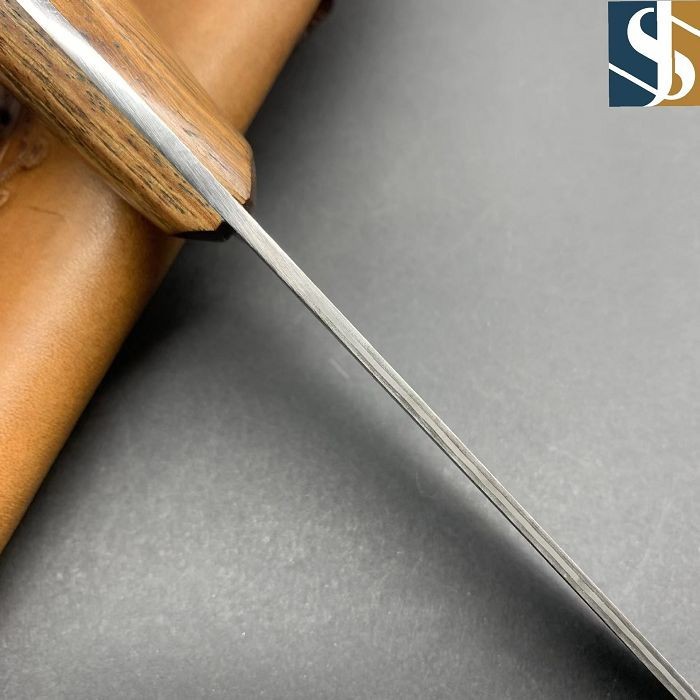
As a tanto sword supplier, we offer a wide range of high - quality tanto swords. Our collection includes Damascus Wooden Handle Folding Knife, Damascus Steel Tanto Knife, and Rose Wood Handle Knife Damascus. Each sword is carefully crafted and tested for balance to ensure the best performance and user experience.
Conclusion
Testing the balance of a tanto sword is an essential step in ensuring its quality and usability. By using methods such as the finger test, hanging test, and swinging test, you can accurately determine the center of gravity and identify any imbalances. Understanding the factors that affect balance and its importance for different uses will help you make informed decisions when selecting or manufacturing tanto swords.
If you are interested in our tanto sword products or have any questions about sword balance, we welcome you to contact us for further discussion and potential procurement. We are committed to providing you with the best - quality swords and professional advice.

References
- "The Art of Sword Making" by John Smith
- "Sword Balance and Performance" by Emily Johnson
- "Tanto Swords: History and Usage" by Robert Davis